
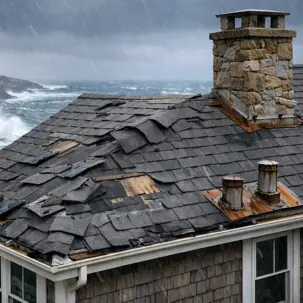
Living near the Rhode Island coast comes with incredible views, but it also exposes your home to some of the harshest roofing conditions in New England. In places like Jamestown, Narragansett, Newport, Bristol, and Warwick, roofs face a constant combination of salt air, wind-driven rain, freeze-thaw cycles, and powerful nor’easters.
That is why cheap roofing materials often fail early on coastal homes. A roof that might perform adequately inland can break down much faster near the shoreline if the system was built with low-grade shingles, weak accessories, or poor installation practices.
Why Coastal Rhode Island Roofs Take More Abuse
Coastal roofs are not just dealing with rain. They are exposed to repeated wind uplift pressure, moisture-heavy air, and storms that can test every weak point in the roofing system.
During a nor’easter or strong coastal storm, wind can lift the edges of lower-grade shingles, especially if the roof was installed with minimal fastening standards or aging seal strips. Once shingles loosen, crease, or tear away, wind-driven rain can reach the underlayment and roof deck quickly.
How Cheap Roofing Systems Fail Near the Ocean
The problem is rarely just the shingle itself. Coastal failures often happen because the entire system was built to a low price point.
Basic 3-tab shingles are thinner and generally less wind-resistant than architectural shingles. Lower-grade fasteners and flashing components may also corrode faster in salt-heavy air. Over time, that corrosion can affect the stability of the roof system, especially around penetrations, valleys, and chimney transitions.
Salt air can also accelerate wear on exposed metal components, while moisture and freeze-thaw cycling can shorten the life of lower-quality roofing materials. For coastal homes, small weaknesses can turn into major leaks much faster than homeowners expect.
Why Architectural Shingles Perform Better on Coastal Homes
For many Rhode Island coastal properties, architectural asphalt shingles are a much better fit than builder-grade materials.
Architectural shingles are thicker, heavier, and designed to provide stronger performance against wind and weather. When paired with the right underlayment, ice and water protection, ventilation, and corrosion-resistant accessories, they create a more durable roofing system for homes exposed to ocean conditions.
They also improve curb appeal. Many homeowners in coastal communities want a roof that not only performs better, but also looks appropriate on a higher-value home. Dimensional architectural shingles can provide a cleaner, more upscale appearance than flat 3-tab products.
Why Installation Quality Matters in Nor’easter Country
Even a premium shingle can fail if the installation is careless. Coastal roofing requires attention to fastening patterns, flashing details, ventilation, and water management.
Mighty Dog Roofing of Rhode Island holds elite manufacturer-backed credentials, including Owens Corning Platinum Preferred and CertainTeed 5-Star Siding Contractor status. Those credentials reflect advanced training and allow access to stronger warranty options when systems are installed to manufacturer specifications.
Why a Post-Storm Inspection Matters
Not all storm damage is obvious from the ground. A roof can suffer lifted shingles, broken seals, granule loss, or flashing damage without leaving dramatic debris in the yard.
That is why post-storm inspections are especially important for coastal homes. Mighty Dog Roofing of Rhode Island uses advanced drone inspections to safely document visible roof conditions, helping homeowners identify potential storm damage before it turns into a larger leak or interior repair issue.
If you own a home near the Rhode Island coast, the best defense is a roofing system designed for the environment, not the cheapest option on the estimate.
Rhode Island Service Locations:
Ashaway, Barrington, Bradford, Bristol, Carolina, Central Falls, Charlestown, Chepachet, Clayville, Coventry, Cranston, Cumberland, East Greenwich, East Providence, Exeter, Forestdale, Foster, Glendale, Greene, Greenville, Harrisville,Hope,Hope Valley, Hopkinton, Jamestown, Johnston, Kenyon, Kingston, Lincoln, Little Compton, Manville, Mapleville, Middletown, Narragansett, Newport, North Kingstown, North Providence, North Scituate, North Smithfield, Oakland, Pascoag, Pawtucket, Portsmouth, Providence, Riverside, Rockville, Rumford, Saunderstown, Shannock, Scituate, Slatersville, Smithfield, Tiverton, Wakefield, Warren, Warwick, West Greenwich, West Kingston, West Warwick, Westerly, Wood River Junction, Woonsocket, Wyoming
FAQ
What is the best type of shingle for a coastal Rhode Island home?
Architectural asphalt shingles are often a strong choice for coastal Rhode Island homes because they offer better wind resistance, durability, and curb appeal than basic 3-tab shingles.
Does salt air damage roofing materials?
Yes. Salt-heavy coastal air can accelerate corrosion on metal roofing components such as fasteners and flashing, especially if lower-quality materials were used.
Why do shingles blow off during a nor’easter?
Shingles may blow off when they are low-grade materials, improperly fastened, or already weakened by age and weather exposure. Strong coastal winds can exploit any weak point in the system.
Are cheap shingles a bad idea near the ocean?
In many cases, yes. Lower-cost roofing materials may not hold up as well against coastal wind, moisture, and salt exposure, which can shorten the roof’s lifespan.
How can I tell if a coastal storm damaged my roof?
Some damage is visible, such as missing shingles, but other issues like lifted seals, flashing damage, or granule loss may require a professional inspection to identify.