
When you get three quotes for a roof replacement in Rhode Island, it is not unusual to see one bid come in $3,000 to $4,000 cheaper than the rest.
It is tempting to grab the lowest price.
Before you sign anything, ask one critical question:
“Are you installing a 3-tab shingle, or an architectural shingle?”
A common way shady contractors lower bids is what homeowners experience as a “builder-grade substitution.” The quote sounds fine, but the materials are quietly downgraded.
Here is how it happens, why it matters in Rhode Island weather, and what you should demand in writing.
The 3-tab vs architectural difference (in plain English)
Most asphalt shingle roofs fall into two broad categories.
3-tab shingles (builder-grade)
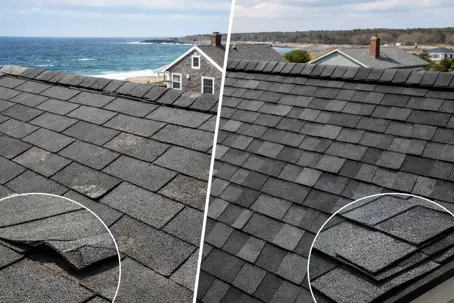
3-tab shingles are flat, single-layer shingles. They are typically the lowest-cost option and are often used on high-volume builds where the goal is to minimize material cost.
They can look fine on day one, but they generally have less thickness and less “meat” to resist wind lift and long-term wear.
Architectural shingles (laminated / dimensional)
Architectural shingles are multi-layered (laminated) and have a thicker, dimensional profile that can mimic wood shake or slate.
In general, they are heavier, more durable, and better suited for the wind and weather swings we see in Rhode Island.
How the “builder-grade substitution” happens
The trick is not always what the salesperson says.
It is what the contract does NOT say.
A vague proposal might read:
“Asphalt shingle roof replacement”
If the shingle type and exact product are not specified, the contractor can often legally fulfill the contract using the cheapest shingle that meets the generic description.
That is how a quote can look like a deal while quietly delivering a lower-grade roof.
Why 3-tab shingles can fail faster in Rhode Island
Rhode Island roofs deal with:
- Coastal wind and wind-driven rain
- Nor’easters
- Freeze-thaw cycles
- Ice and snow loads
A thinner, lower-profile shingle is more likely to show problems sooner, especially if the roof system details (starter strip, ridge cap, underlayment, ventilation, and flashing) are also value-engineered.
Wind blow-off risk
Many 3-tab systems are associated with lower wind resistance than premium architectural systems.
In places like Warwick, Cranston, and along the coast, winter storms can push wind gusts that test the roof edge details.
If the shingle system is light and the install is rushed, homeowners can see:
- Tabs lifting
- Creasing
- Missing shingles after storms
Shorter real-world lifespan
Even when a product has a stated “years” label, real-world performance depends on climate and installation.
In Rhode Island, cheaper shingles can show earlier wear like:
- Granule loss
- Curling
- Brittle edges n ## What to demand in writing (so you know what you are buying) Before you sign, ask for the estimate to list:
- Shingle type: 3-tab or architectural
- Exact manufacturer + product line
- Color name
- Wind rating (as stated by the manufacturer)
- Underlayment type
- Ice and water barrier locations
- Starter strip and ridge cap product
- Flashing scope (chimney, walls, skylights, vents)
- How decking repairs are priced and documented
If a contractor will not put the product in writing, that is the answer. Lear more here
The Mighty Dog standard
At Mighty Dog Roofing of Rhode Island, we do not win jobs by quietly downgrading materials.
As an Owens Corning Platinum Preferred and CertainTeed 5-Star contractor, our quotes are built around high-quality architectural shingle systems and a complete scope you can review.
If a price seems too good to be true, check the materials.
A cheap roof today can turn into an expensive leak tomorrow.
If you have a quote in hand and you are not sure what grade of shingle is included, we can help you compare apples to apples.
Call (401) 425-4108 or visit our Contact Us page to schedule an inspection.
Rhode Island Service Locations:
Ashaway, Barrington, Bradford, Bristol, Carolina, Central Falls, Charlestown, Chepachet, Clayville, Coventry, Cranston, Cumberland, East Greenwich, East Providence, Exeter, Forestdale, Foster, Glendale, Greene, Greenville, Harrisville,Hope,Hope Valley, Hopkinton, Jamestown, Johnston, Kenyon, Kingston, Lincoln, Little Compton, Manville, Mapleville, Middletown, Narragansett, Newport, North Kingstown, North Providence, North Scituate, North Smithfield, Oakland, Pascoag, Pawtucket, Portsmouth, Providence, Riverside, Rockville, Rumford, Saunderstown, Shannock, Scituate, Slatersville, Smithfield, Tiverton, Wakefield, Warren, Warwick, West Greenwich, West Kingston, West Warwick, Westerly, Wood River Junction, Woonsocket, Wyomin
FAQ
What is the difference between 3-tab and architectural shingles?
Architectural shingles are thicker and multi-layered (laminated), while 3-tab shingles are flatter and typically a lower-cost, single-layer option.
Are architectural shingles worth the extra money in Rhode Island?
For many Rhode Island homeowners, yes. The added thickness and system options of architectural shingles generally perform better in wind and weather swings than entry-level shingles.
How do I know what shingles a roofer is installing?
Ask for the exact manufacturer and product line in writing on the estimate and contract. If it only says “asphalt shingles,” the grade may not be specified.